Wow!
That was one of those once in a lifetime moments.
It had just stopped snowing for a minute, so I ran outside to take some trash out. (No, that was not the once in a lifetime part, smart @$$).
As I was walking back into the lodge, I heard a crow screaming LOUDLY! I looked across the street just in time to see what I thought was 2 crows mating, locked in an amorous embrace, drop from the sky and hit the ground about 30 feet from me. As the crow continued screaming, I caught a flash of lighter colored feathers and realized one of the crows was a hawk.
Then I heard some more crows cawing. and 10 or 20 crows flew down out of the sky and began attacking the hawk, while screaming themselves.
I ran to the door and yelled for Juanita to come FAST, without taking my eyes off of the ongoing rescue operation.
By the time Juanita got to the door there were over 100 crows screaming bloody murder and darting out of the sky taking turns attacking the hawk. The hawk seemed to decide dinner was off and fled the scene. All of the crows swarmed him in pursuit, still screaming bloody murder (Except for dinner, who got up, limped around for 30 seconds or so, and then flew off in the other direction.)
The raucous cacophony of crow calling gradually faded as the black cloud of birds pursued their intended quarry with a single minded purpose, off into the distance.
I stood, heart pounding, and realized 2 things about myself.
1) I will stop and turn my car around to keep from running over one of these birds lest his whole family decides to take me out.
and
2) I really have no idea how crows mate.
Bill
Showing posts with label I'll Learn You Somethin'. Show all posts
Showing posts with label I'll Learn You Somethin'. Show all posts
Tuesday, April 17, 2018


Sunday, April 2, 2017
Harnessing 101 (long video)
Farm Days in La Junta, CO.
Friends of ours have been asking us to join them there for several years
now. If you want to see big teams – as
in draft horses – work, it’s the place to be in the Spring. I had an ulterior motive this year; I want to
teach Jesse to drive and there would be a well-known harness maker and trainer
there. In fact, it’s at his farm
site. The idea of the weekend is to get
his fields plowed and ready for planting – using horses instead of
tractors. He owns four well-trained gray
drafts and there were going to be several other teams; everyone there to pull a
plow or disc or whatever was needed. I
was promised huge information on all things to do with harnesses, driving,
horses, and a great time. I must say,
the information part turned out to be overwhelming.
When we arrived on Friday, the teams were just coming in
from the day’s work in the field. We
stood around in awe of the giant animals moving around us; some of every
different breed; even a couple teams of mules; some matched; some mismatched;
very large ones and a Halflinger team; one that appeared to be Mustangs.
Dinner was served cowboy style; outdoors on planks set up on
props; a cook fire going outside as well as inside the bunkhouse. We all pitched in somehow, whether helping to
setup, cook, clean up afterwards. The
kids got put to work; nobody was left out.
And of course, afterwards, the music started with first one
guitar/singer, then another adding in, and another. You could just sit and listen to the
wonderful old cowboy ballads or join in the singing. Talk about days gone by!

My big objective was to learn all I could about fitting and
harnessing horses, before I actually bought tack for Jesse. On Saturday the plan was to spend as much
time as possible ‘shadowing’ the ones with the info. Del is a local legend in the
industry and was willing to take me under his wing. It was like drinking from a firehose,
following him around. He had brought his
horses in and tied them off on a trailer.
I was pointed to curry and told to get busy. Lots of white hair flying and are these guys
BIG?! We took a break for breakfast and
then the real work started.
Del was great about explaining how and why for all parts of
the harness. I watched him harness three
of the horses, then was told, “Your turn.”
What? OK, I got this. Want to take a guess what all those straps
weigh? When you get the collar and the
rest of the harness, you can have anywhere from 75 to 100 lbs., depending on
how fancy you want to get.
The fun starts when you get to sit on the collar and bounce
up and down to ‘round it back out’, since when you hang it up, it is wet and
tends to elongate downward as it dries.
You have to get it back to a rounder shape to put over the horse’s
head. Some of this stuff is done differently
than for the show horses. Remember,
these are work horses headed out into the fields, and they and their gear come
back mighty sweaty and dusty. Now you
get to lift this (maybe 20 lb.) collar onto the horse by pushing it over their
face – nose, eyes, ears – and settling it down just above the withers. Not bad when you have a great horse who helps
by sticking her nose in and pushing to get the ears through.
Next, get the rest of the harness settled on your arm and
lift off the hook. Much easier said than
done, and then you get to settle this mass on your hip and kind of hitch
yourself over to the horse. Feels like
it weighs about what my 50lb. saddle does, and most of the time I can get it slung over my horse. But this is a totally different configuration,
lots of straps hanging down to the ground, and by the way, the horse is 16 or
17+ hands (at least 8 inches taller than my mare in the real world).
I give it a good toss – and it goes nowhere near where it should. Del says to squat down to the ground and give a big heave. Right! I try again and sort of get most of the straps up and part way over; Del comes to the rescue and helps me shove it the rest of the way. Obviously, there is a practiced technique to this. He shows me how to set the hames in the groove on the collar and bind them into place. He isn’t any bigger than me so I have to laugh when he literally swings all his weight on the buckle to get it tight enough. Then the buckling up starts, walking around the horse connecting straps as you go, pulling the breeching over the rump and getting the tail settled over the strap, and making sure everything is absolutely straight, so you don’t cause any sores.
I give it a good toss – and it goes nowhere near where it should. Del says to squat down to the ground and give a big heave. Right! I try again and sort of get most of the straps up and part way over; Del comes to the rescue and helps me shove it the rest of the way. Obviously, there is a practiced technique to this. He shows me how to set the hames in the groove on the collar and bind them into place. He isn’t any bigger than me so I have to laugh when he literally swings all his weight on the buckle to get it tight enough. Then the buckling up starts, walking around the horse connecting straps as you go, pulling the breeching over the rump and getting the tail settled over the strap, and making sure everything is absolutely straight, so you don’t cause any sores.
Time for the bridle.
That head is a long way up there and these guys don’t figure it
necessary to teach your horse to lower its head and be accommodating. However, this mare was great about lowering
her head when I asked, taking the bit like a lady and being patient because I
had never handled blinders before, which are permanently attached to the
bridle.
Now for the reins, all 25 ft. of them. Sling them over the back and out onto the
ground behind, then thread them through the proper spots and attach to the bit
on the left side of the horse to be on the left. Repeat on the right side of the horse to be
on the right. Now, to hook them together
in the middle and learn how the reins work, so you as a driver only have two
reins in your hands to signal two horses to do the same thing.
Then I got to watch Del move the team to the plow and get it hitched up, again getting instructions on the proper order of attaching the harness to the tongue of the plow. By this time, I was beginning to feel like I had info overload, so I just watched the plowing for the rest of the morning!
Thursday, January 9, 2014
At Breakfast This Morning
At breakfast this morning, while talking with our guests, the
conversation went to horses. No surprise there, it often does. You
know how horse people are.
We were discussing what we had learned about horse communication, and how it helped in training our mustangs. One of our guests asked if we knew whether different herds in the wild used different "dialects" in horse language. As it turns out he had read several articles on orca (killer whales) and that different pods of whales, even neighboring ones, used different "words" to communicate with their pod members, as compared with the neighbors. I said I didn't think horses had any particular dialects, as theirs is a visual language consisting of pinned ears, bared teeth, bugged eyes and the like. Not much room for accents.
The conversation went on to what our guest's current job was. A freelance cultural anthropologist. Apparently he was in fairly high demand, as not a lot of US citizens speak much Mayan.
Cool.
We talked for quite some time about his trips to southern Mexico, and how difficult it was to find a good representation of the Mayan language, because, like the killer whales, different villages use a lot of different words. And now there is a huge amount of Spanish mixed in.
Surprisingly, there is no Mayan word for "internet", or even "telephone". Who have thunk.
I love my job.
Bill
We were discussing what we had learned about horse communication, and how it helped in training our mustangs. One of our guests asked if we knew whether different herds in the wild used different "dialects" in horse language. As it turns out he had read several articles on orca (killer whales) and that different pods of whales, even neighboring ones, used different "words" to communicate with their pod members, as compared with the neighbors. I said I didn't think horses had any particular dialects, as theirs is a visual language consisting of pinned ears, bared teeth, bugged eyes and the like. Not much room for accents.
The conversation went on to what our guest's current job was. A freelance cultural anthropologist. Apparently he was in fairly high demand, as not a lot of US citizens speak much Mayan.
Cool.
We talked for quite some time about his trips to southern Mexico, and how difficult it was to find a good representation of the Mayan language, because, like the killer whales, different villages use a lot of different words. And now there is a huge amount of Spanish mixed in.
Surprisingly, there is no Mayan word for "internet", or even "telephone". Who have thunk.
I love my job.
Bill
Sunday, December 11, 2011
Rodeo 101
A Rodeo Primer
When Juanita and I get tired of watching people and animals at the lodge, we take a break and go to a rodeo. Where we watch people and animals in an arena. This year we were not able to go the the Rodeo National Finals in Las Vegas, missing it for the first time in years. But we are still thinking about it.
Some of you may not know much about rodeos so here is a short description of the events.
Rough stock events: Bareback, Saddle Bronc and Bull Riding. Cowboys try to stay seated on an animal that is trying to get rid of them. They attempt to ride for 8 seconds in a row. Half of the points (up to 50) are determined by the animal, the other half (also up to 50, ain’t math GREAT!?!) are awarded to the cowboy. Touching themselves or the animal with their free hand disqualifies the cowboy.
Timed events (Steer Wrestling, Team Roping, Tie Down Roping, Barrel Racing) are, well, timed events. Fastest time wins. Penalties are given in seconds for infractions, adding to final time.
Bareback Riding:
Probably my favorite event. The horses are smaller, and appear to be bucking harder than the other "rough stock". The cowboys in this event look like they are being BEAT HALF TO DEATH.

The horses seem to be having fun.
Saddle Broncs:
This may be my favorite event. The skill of the cowboys, and the technique that they demonstrate in the spurring to the rhythm of the animals bucking is just amazing to watch.

These horses also seem to be having fun trying to unload the fools.
Steer Wrestling:
Quite possibly my favorite event. Huge cowboys leaping off of horses traveling at 30 miles per hour onto the ground and grabbing the head of a 600 pound steer running at 30 miles per hour, dragging it to a stop, and twisting it over onto its back. Sheer genius.

The horses are having a good time, the steers, maybe not so much. They're pretty annoyed.
Team Roping:
This has got to be my favorite event to watch, because it isn't possible. One cowboy ropes the head of a calf (Okay, I can see how you can do that), but the other cowboy ropes both hind legs, and then they stretch the little booger out. How in the heck can you throw a rope around both hind legs of a 4 legged critter running away from you full speed while you are sitting on a running horse. Just can't be done.

Horses having fun, calves... well, mostly just kinda surprised.
Tie Down Roping:
I may like this event the best because of the sheer number of things that MUST go right to get a good score.
From horseback, you rope a calf, tie the roped off calf to your saddle, as you jump off your horse, your horse backs up just enough to keep the calf from running off. Then you run over, throw the calf down, and tie together its legs in the least amount of time possible.

Bovine bondage at its best. The horses usually know and enjoy their job. Calves are again, surprised.
Bull Riding:
I find I root for the animals more than the cowboys in most events, so this one is my favorite. Smallest cowboys, largest rough stock. Remember those little cattle in the other events? I think the bulls are just getting even. They try to buck the cowboys off of their backs, and then turn to kill them.
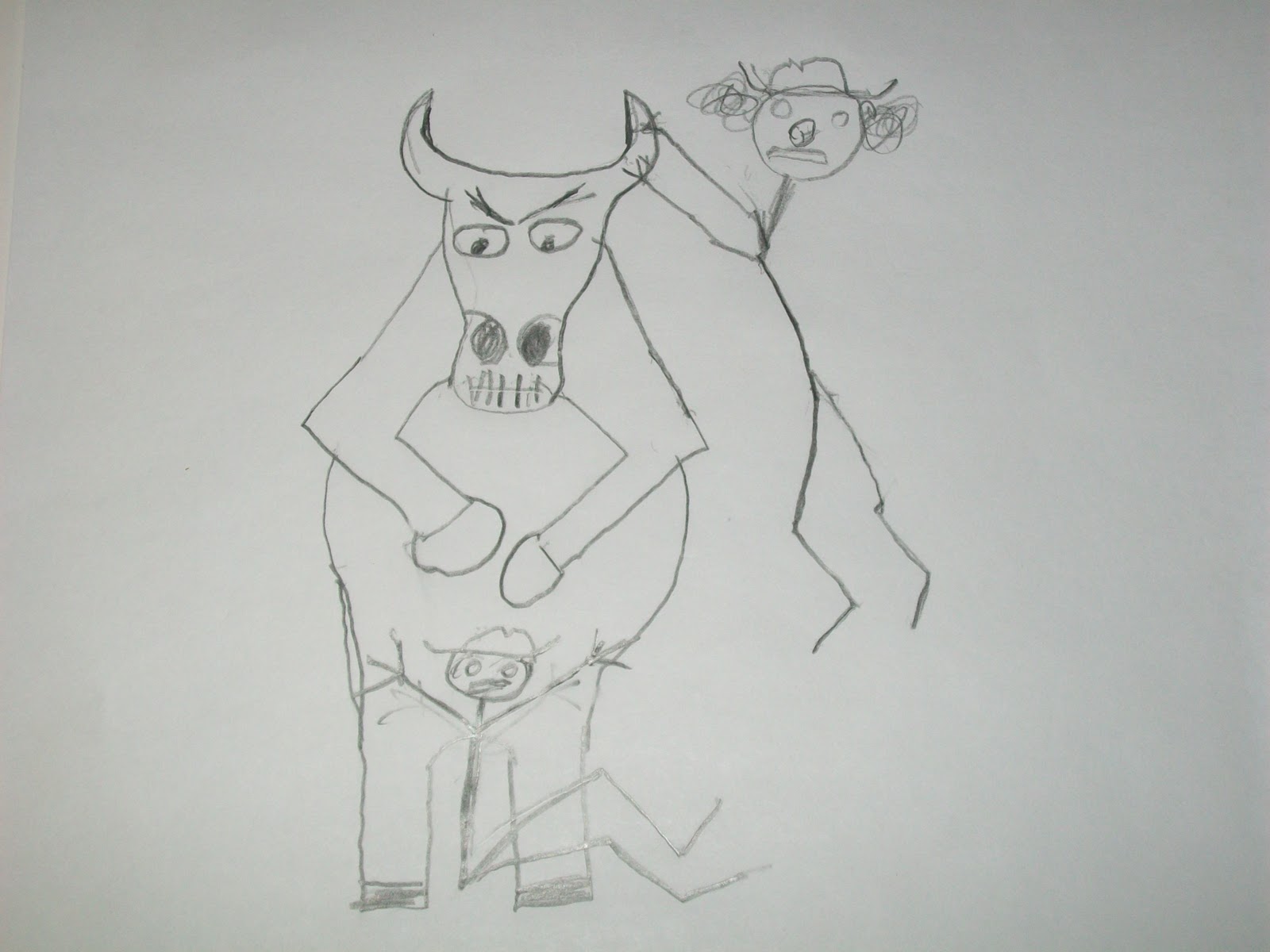
Bulls are DEFINITELY having a good time. The surviving cowboys seem happy, too. (Maybe just glad to be alive...)
Applause to the rodeo clowns, they really save lives in this event.
Barrel Racing:
Okay, this is ABSOLUTELY my favorite. Pretty girls and fast horses. What's not to like?

Not much of a race though. The horses ALWAYS win. The barrels hardly ever even MOVE.
Bill
Wednesday, August 31, 2011
Colic 101
Last few days our blog has mostly been about "Colic". Some of you non-horsey types may not understand the disease, so here is a quick primer on it.
Colic is a general term for "pain in the gut" (not pain in the butt). When you have a "colicky" baby it's usually not life threatening to the infant, at least not since the "Don't Shake the Baby" campaign got started. In people, it's mostly just pain from gas or cramping.
Colic in horse's is different. It can be, and often is, fatal. The severity of colic in horses is due to the design of the horses digestive system, and how they are being fed and housed. A wild horse has access to feed 24 hours a day, 7 days a week, but has to walk 10 to 20 miles a day to get it. That goes a long way toward keeping things moving in their gut. Most domestic horses have a couple bigger meals each day, and stand in a pen an awful lot of the time. They don't much mind, because it is easier to find their forage (it shows up magically after they holler for a few minutes), but their systems need more work to work.
Colic is most dangerous when it is a blockage of some sort in the horses digestive system, and it's a big system.
*5 feet of esophagus. (swallow tube)
*Stomach. (4 gallon capacity)
*70 feet of small intestine (where most nutrients are absorbed)
Then you get to the large intestine.
*4 feet of the "cecum", an interesting organ that has no real counterpart in humans. It's an 8 gallon bladder that holds a grass soup so bacteria can break down the soup into components that the intestines can absorb. A number of colic's are caused here by changing the feed the horse eats too quickly, and not having the right bacteria in the gut for fermentation of the new food. (I suspect the same problem is seen in humans with gluten intolerance. If you go for a couple weeks eating no gluten, the bugs in your gut that break it down will starve. Then when you start again, AARRRG! Colic!)
Question---I wonder, if you gave a horse brewers yeast, would they make beer in the cecum?
*12 feet of large colon (absorb carbohydrates, which were broken down from cellulose in the cecum.)
*12 feet of small colon (absorbs the water from the soup and turns the poop into balls)
*1 foot of rectum (Holding chamber)
Tooth to tail you end up with over 100 feet of tubing that holds nearly 50 gallons of primordial soup, in an animal that can't even burp. If any thing goes wrong (kinks, blockages, etc) the animal will be in great distress, and may die.
Years ago, I talked with a vet about the types of problems he most often saw in horses. He told me "Four legs and a gut, that's all horses are. If you can work on those, you have over 90% of the problems covered."
Makes my little bit of heartburn seem kind of... insignificant.
Bill
Colic is a general term for "pain in the gut" (not pain in the butt). When you have a "colicky" baby it's usually not life threatening to the infant, at least not since the "Don't Shake the Baby" campaign got started. In people, it's mostly just pain from gas or cramping.
Colic in horse's is different. It can be, and often is, fatal. The severity of colic in horses is due to the design of the horses digestive system, and how they are being fed and housed. A wild horse has access to feed 24 hours a day, 7 days a week, but has to walk 10 to 20 miles a day to get it. That goes a long way toward keeping things moving in their gut. Most domestic horses have a couple bigger meals each day, and stand in a pen an awful lot of the time. They don't much mind, because it is easier to find their forage (it shows up magically after they holler for a few minutes), but their systems need more work to work.
Colic is most dangerous when it is a blockage of some sort in the horses digestive system, and it's a big system.
*5 feet of esophagus. (swallow tube)
*Stomach. (4 gallon capacity)
*70 feet of small intestine (where most nutrients are absorbed)
Then you get to the large intestine.
*4 feet of the "cecum", an interesting organ that has no real counterpart in humans. It's an 8 gallon bladder that holds a grass soup so bacteria can break down the soup into components that the intestines can absorb. A number of colic's are caused here by changing the feed the horse eats too quickly, and not having the right bacteria in the gut for fermentation of the new food. (I suspect the same problem is seen in humans with gluten intolerance. If you go for a couple weeks eating no gluten, the bugs in your gut that break it down will starve. Then when you start again, AARRRG! Colic!)
Question---I wonder, if you gave a horse brewers yeast, would they make beer in the cecum?
*12 feet of large colon (absorb carbohydrates, which were broken down from cellulose in the cecum.)
*12 feet of small colon (absorbs the water from the soup and turns the poop into balls)
*1 foot of rectum (Holding chamber)
Tooth to tail you end up with over 100 feet of tubing that holds nearly 50 gallons of primordial soup, in an animal that can't even burp. If any thing goes wrong (kinks, blockages, etc) the animal will be in great distress, and may die.
Years ago, I talked with a vet about the types of problems he most often saw in horses. He told me "Four legs and a gut, that's all horses are. If you can work on those, you have over 90% of the problems covered."
Makes my little bit of heartburn seem kind of... insignificant.
Bill
Subscribe to:
Posts (Atom)